
You’re laying your seven-week-old down for the second nap of the day when the late-afternoon light catches their cheek at a new angle. There, on the side they’d been sleeping on, is a fresh patch of red bumps. You stand over the bassinet for a second too long, parent-brain already running through a list.
Most likely you’re looking at one of three things: baby acne, eczema, or a heat rash. “Baby acne or eczema?” is the comparison parents email us about most, and once you know what to compare, the differences are easier to spot than you’d think.

What’s the quickest way to know the difference between baby acne and eczema?
The fastest way to tell them apart is to look at three things: the texture of the bumps, where they live on the body, and whether your baby seems bothered by them.
|
Baby Acne |
Baby Eczema |
Heat Rash |
|
|---|---|---|---|
|
Looks like |
Tiny red bumps or whiteheads |
Dry, scaly, inflamed patches |
Pinprick red or clear bumps |
|
Texture |
Slightly raised, smooth |
Rough, flaky, sometimes weepy |
Prickly, sometimes blistery |
|
Where it shows up |
Cheeks, nose, forehead |
Cheeks, scalp, elbow and knee folds, arms, legs |
Neck, chest, diaper area, under clothing |
|
When it appears |
2 to 6 weeks old |
First 6 months, often around 3 months |
Anytime, usually in heat |
|
Itchy? |
No |
Very |
Mildly |
|
How long it lasts |
Weeks |
Chronic; flares come and go |
Hours to a few days |
If the bumps are smooth, sit only on the face, and your baby seems unbothered, you’re most likely looking at baby acne. If the patches feel sandpapery, show up in skin folds, and your baby is scratching or fussy at bath time, eczema is the more likely answer.
What causes baby acne?
Baby acne is mostly a hormone story. During pregnancy, maternal hormones pass through the placenta and wake up your baby’s still-sleepy oil glands. The extra sebum clogs tiny pores, and in some babies it also triggers a small immune response to a yeast called Malassezia that lives naturally on skin.
-
Maternal hormones - these are passed from mother to baby through the placenta during pregnancy and before birth. They wake up your baby’s oil-producing glands, causing them to have extra sebum (an oily substance meant to protect skin and hair).
-
Clogged pores - having too much sebum clogs your baby’s pores, causing those little bumps to appear.
-
Yeast overgrowth - the extra sebum on your baby’s face can cause an inflammatory reaction to Malassezia yeast which also results in red bumps on the face.
-
Sensitive newborn skin - your little babe has sensitive skin, and it may react to milk residue, drool, spit-up, or vomit left on their skin.
-
Other irritants - while not as common, some irritants like harsh laundry detergents or oily skin products can create baby acne or similar-looking rashes.
The American Academy of Pediatrics estimates that about 20% of newborns develop some form of acne, usually between two and six weeks old.
A few things that do not cause baby acne, despite what your group chat might say:
-
Anything you ate during pregnancy or while nursing
-
Kissing your baby’s cheeks
-
Using the wrong laundry detergent (in most cases)
-
A skincare routine “gone wrong”
How do you treat baby acne?
Typically, baby acne can resolve itself on its own. But we have a few tips that can help:
-
Wash the face with lukewarm water once a day; a drop of a gentle, fragrance-free cleanser is fine.
-
Pat the skin dry, never rub.
-
Wipe milk, drool, and spit-up off cheeks quickly so it doesn’t sit on the skin.
-
Skip oily lotions, fragranced wipes, and anything labeled for adult acne.
-
Don’t squeeze, pick, or scrub acne bumps.
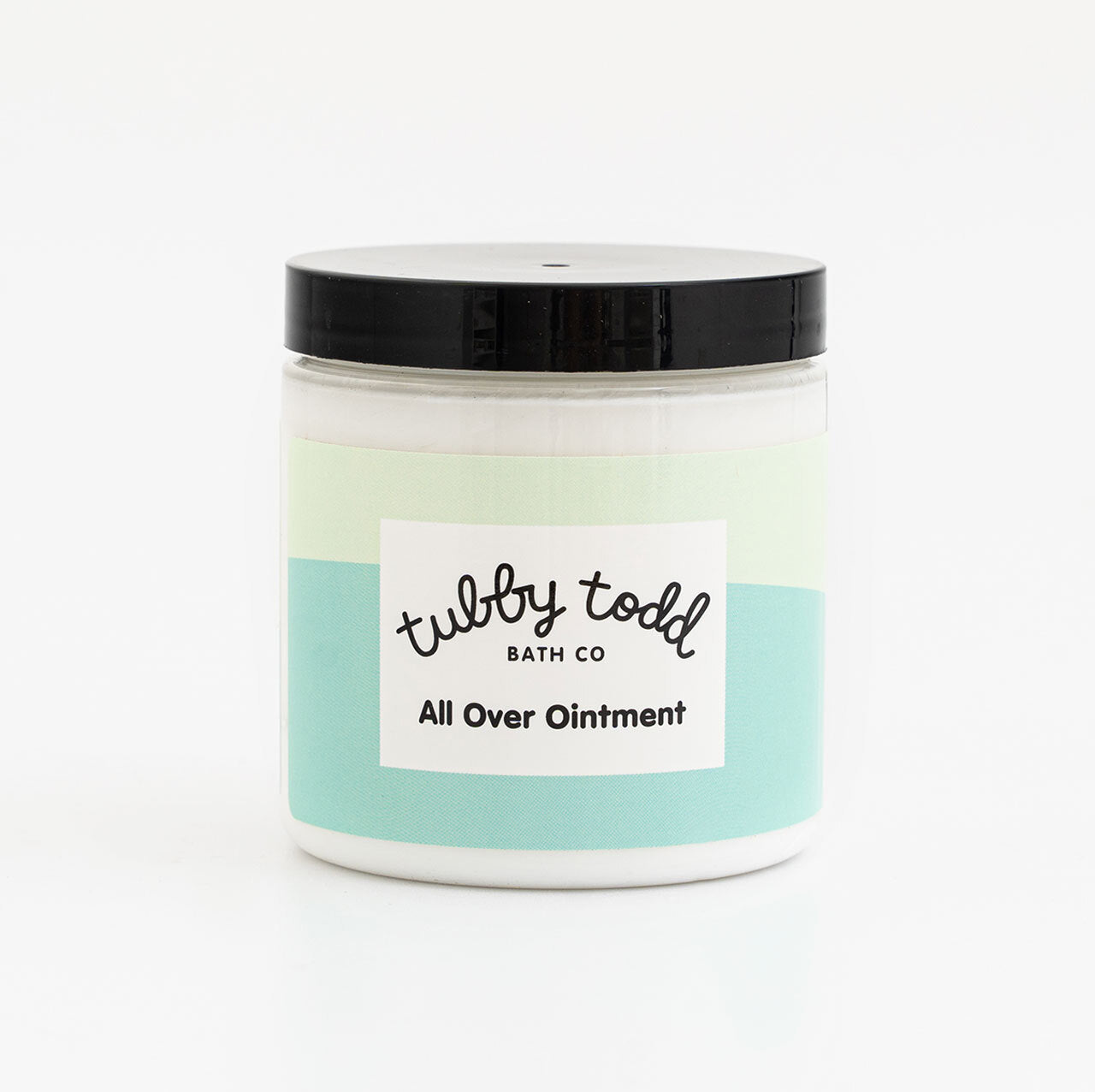
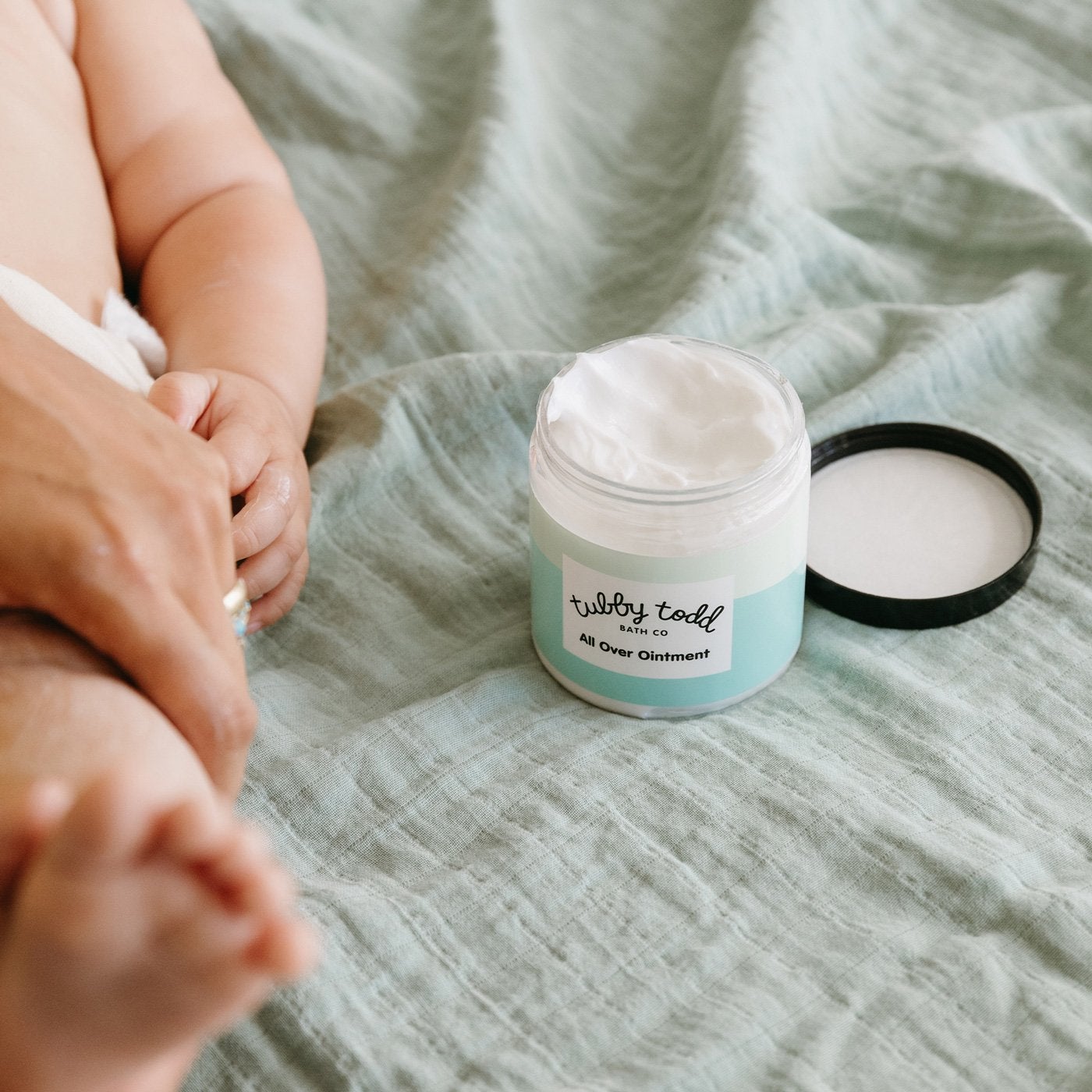
If the patches look angry or your baby seems uncomfortable, a thin layer of our All Over Ointment can calm irritation without clogging pores. It’s lanolin-free, fragrance-free, and sits on the gentler end of what pediatric dermatologists recommend.
What causes baby eczema?
Eczema is a different animal. It’s a chronic condition with several overlapping causes.
Genetic factors - If you, your partner, or a sibling has eczema, asthma, or seasonal allergies, your baby has up to a 75% chance of developing eczema, according to research published in the Journal of Pediatrics.
Skin barrier dysfunction - Babies with eczema often have a mutation in the filaggrin gene, which means their skin can’t hold water in or keep irritants out as effectively.
An overactive immune response - Eczema-prone skin reacts to triggers most other babies brush off.
Environmental triggers - Pet dander, pollen, dust mites, fragrance, hard water, certain detergents, and food allergens (most commonly milk, eggs, and peanut) can all set off a flare.
Put simply: baby acne is a moment. Eczema is a long-term relationship between your baby’s skin and their environment. The National Eczema Association estimates about 9.6 million U.S. children live with it, and many show symptoms before their first birthday.
How do you treat baby eczema?
The tricky thing about eczema is that it’s not a one-time fix. Eczema needs a routine to keep it dormant. The framework most pediatric dermatologists recommend, and what we pass along to our customers:
-
Bathe smart, not less. The old advice was to bathe eczema-prone kids as little as possible, but current AAP guidance leans the other way: daily or every-other-day baths are fine, as long as they're short (5 to 10 minutes) and lukewarm. The water itself is hydrating. What happens in the next three minutes is what matters.
-
Skip bubble bath and harsh cleansers. Use a gentle, fragrance-free wash only where it's really needed — the diaper area, hands, scalp. Our Hair + Body Wash was formulated for exactly this. Pat dry with a soft towel, no rubbing.
-
Lock in moisture within three minutes. Skin still damp, towel still in hand, slather on the lotion. Our Everyday Lotion is a good head-to-toe baseline for most nights.
-
Spot-treat the patches with an ointment. For active flares, a heavier, more occlusive product works harder than a lotion alone. Our All Over Ointment was originally formulated for the founder's son, and it's now backed by more than 17,000 five-star reviews from parents in the same trenches. For really stubborn spots, layer Barrier Balm on top.
-
Build the routine in one bundle. If you'd rather not piece a routine together from scratch, the Regulars Bundle is the three-step lineup we recommend most for eczema-prone families: wash, moisturize, treat.

When should you call your pediatrician?
For baby acne, you usually don’t need to. But, if you’re concerned about it, you can bring it up at the next well-check.
For eczema or any unidentified rash, call sooner if you see:
-
A rash that’s spreading quickly
-
Yellow crust, oozing, or any sign of infection
-
Fever along with the rash
-
Sleep disruption or scratching to the point of bleeding
-
No improvement after a couple of weeks of consistent moisturizing
A pediatric dermatologist can confirm eczema and rule out look-alikes like cradle cap, contact dermatitis, or hives.
How do you care for baby skin from here?
Hopefully we’ve relieved some of the parent panic after seeing fresh bumps on your newborn’s face. The general rule of thumb: smooth bumps that stay on the face and don’t bother your baby are almost always baby acne, and they’ll be gone by month four. Rough, dry, itchy patches that show up in skin folds and come and go are almost always eczema, and they call for a daily moisturizing routine.
We built our line for that second case in particular, and most of our customers stay with us because of it. The All Over Ointment is the product more than 30,000 parents keep within arm’s reach of the changing table.
For a few of our favorite ways to use it, our guide to 4 ways to use Dream Cream for your baby and yourself is a good next read.
Frequently Asked Questions
Can baby acne and eczema show up at the same time?
Yes, it’s not common, but a baby with eczema-prone skin can also go through a hormonal acne phase in the first few months. The acne usually clears first, while the eczema settles into a longer-term pattern.
Does baby acne mean my child will have acne as a teenager?
No, newborn acne and adolescent acne are driven by different things, and one doesn’t predict the other. Your baby’s pimples are a hormonal echo from pregnancy, not a glimpse of their teen years.
Is it safe to use coconut oil on baby acne?
A small amount of pure, fractionated coconut oil is generally safe and has mild antibacterial properties, but it clogs pores on some babies and can actually worsen acne. If you try it and see no improvement (or any flare-up) within a few days, stop.
Is baby eczema contagious?
No, eczema is a skin barrier and immune-response condition, not an infection. Your baby can’t catch it from a sibling and can’t pass it to anyone through contact.
What’s the safest first product to try on eczema-prone newborn skin?
A fragrance-free, dye-free ointment with a short ingredient list. Many parents start with our All Over Ointment because it doubles as a barrier cream for the diaper area, a face moisturizer for dry cheeks, and a flare-time treatment in one jar.
Products in this post