
Looking down at your baby's precious, pinch-worthy leg rolls is one of the most satisfying moments of parenthood. You nourished those plump little skin folds with your undying love and devotion. Nothing can replace that delicious dopamine hit.
But then…oh no. You notice the beginnings of a little eczema on legs, right there in those precious knee folds. A little red, a little rough, and definitely not supposed to be there.
What do you do?
Well, that’s what we’re here for. Consider this your guide to understanding why eczema on legs appears and how to help soothe your little babe's eczema-prone legs at home.
Why does eczema show up on little baby legs?
Baby legs face a unique set of challenges that other parts of the body just don't. Between the friction, the skin folds, and your baby’s still-developing skin barrier, legs are especially prone to eczema flares..
Here's what's going on underneath the surface:
Your baby's skin relies on filaggrin, a protein that helps hold the skin barrier together and keep irritants out. When that barrier is weakened (which is common in babies with eczema-prone skin), sweat, heat, and outside irritants can penetrate more easily, and that's when flares happen. Baby eczema can appear on other parts of the body besides the legs, however, legs are a common eczema flare-up location.
What does eczema on legs look like?
Eczema on baby legs can look a little different depending on where it shows up and your baby's skin tone.
Here's what to look for:
-
Behind the knees - dry, scaly patches are the most common presentation in babies and young children.
-
Knee and elbow folds - red or inflamed skin that your baby keeps rubbing or scratching.
-
Thigh creases and diaper area - irritated skin that may look weepy or raw.
Also, eczema doesn't look the same on every baby. On lighter skin, patches appear pink to red. On darker skin, they may look brown or purple.
One more thing to watch for: if your baby has been scratching, keep an eye out for signs of infection. Yellow crust or small pus bumps around the affected area are a signal to call your pediatrician.
The types of leg eczema your baby might have
For babies and young kids, there are two main types of eczema on legs to look out for:
-
Atopic dermatitis - the most common type of eczema in babies. It's linked to that filaggrin gene mutation, which weakens the skin barrier and makes it easier for irritants to get in. If eczema runs in your family, this is likely what you're dealing with.
-
Contact dermatitis - triggered by something that physically touches the legs. This could be laundry detergent residue left in clothing, dyes in fabric, tight elastic waistbands, or fragranced lotions applied to the skin. The rash usually shows up right where the irritant made contact.
The crawling stage + eczema = itchy little babe
Once your little babe discovers crawling (mainly between 6 and 12 months), they are especially vulnerable to develop eczema on their legs.
Knees and elbows rub against floors, carpets, and clothing all day long, creating constant friction on already-sensitive skin. Then, those adorable skin folds at the knees, thighs, and diaper area trap heat and moisture, making them the perfect environment for a flare-up to develop.

A few things that can help during the crawling stage:
-
Soft, breathable layers on the legs - thin cotton pants or leggings create a gentle barrier between your baby's skin and rough surfaces without trapping heat.
-
Avoid synthetic or rough-textured fabrics - anything scratchy against the knee area is going to make things worse.
-
Soft knee patches or leg covers - these are worth trying for active crawlers with recurring flare-ups right at the knees.
-
Check the floor - carpet can be surprisingly rough on baby skin. Soft play mats can give your crawler a gentler surface to move around on.
Dress your babe to protect their eczema-prone legs
What your baby wears matters more than you might think. The right fabrics can calm eczema-prone skin down. The wrong ones can set off a flare before you even leave the house.
Here's are a few dressing tips to lessen the likelihood of an eczema flare-up:
-
Choose the best fabrics - 100% cotton and bamboo are gentle, breathable, and soft against sensitive leg skin.
-
What to avoid - wool, synthetic blends, and anything with tight elastic around the leg openings.
-
Wash new clothes before wearing them - new clothing can contain formaldehyde and other chemicals from the manufacturing process. A wash before the first wear removes those.
-
Use fragrance-free, dye-free laundry detergent - and skip the fabric softener. The residue left behind in clothing sits against your baby's skin all day.
-
Layer for warmth without overheating - thin, breathable layers are better than one thick, heavy fabric that traps heat against the skin.
How to build a baby legs skincare routine
When it comes to eczema on legs, moisturizing is foundational. And because legs have more surface area than, say, cheeks, you need to be generous with it.
Here's how to build a baby legs skincare routine:
-
Get into the folds - behind the knees, thigh creases, and elbow folds need just as much attention as the flat areas of the leg. That's where eczema likes to hide.
-
Apply right after your bath routine - follow the three-minute rule and get moisturizer on while the skin is still slightly damp. This locks in moisture before it has a chance to evaporate.
-
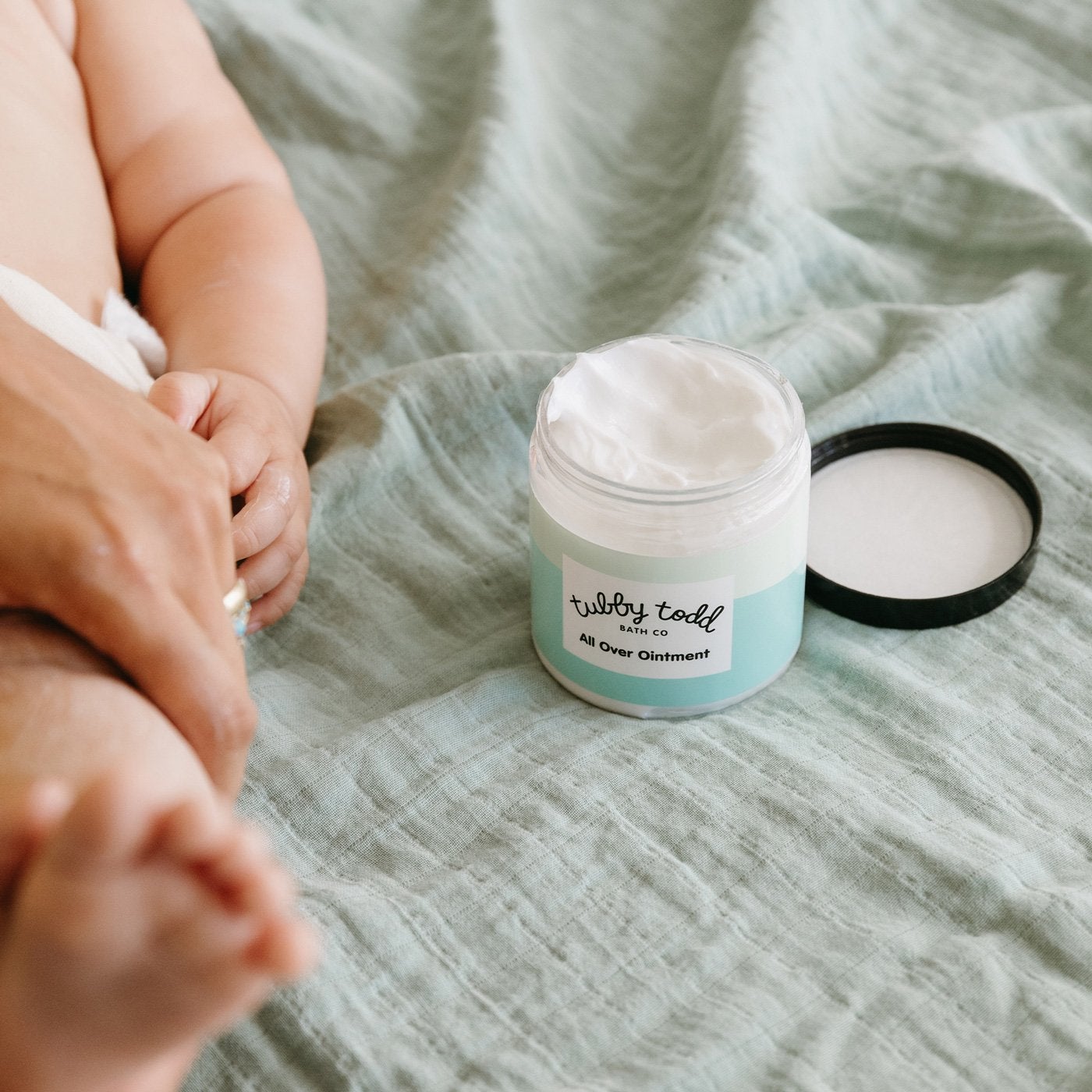
Use the right products for the right spots - our All Over Ointment is great for folds and larger areas, while Barrier Balm is a perfect spot treatment for especially irritated patches.
-
During flares, increase how often you apply - aim for three to four times a day on high-friction areas like the knees and thighs, not just once after a bath.
If you want a complete routine that covers cleansing, moisturizing, and protecting all in one, our Barrier Bundle was made exactly for this.

Your baby’s leg rolls deserve the best
While eczema on baby legs is frustrating, it's also manageable. And with the right routine and the right products, those precious little leg rolls will feel soft and comfortable again.
We know nourishing those sweet baby legs was no small feat. You already did the hard part. The least we can do is help you take care of your little babe’s eczema-prone legs.
Take a peek at our eczema-friendly products that thousands of moms are already swooning over, and try out a few for your babe.
Frequently Asked Questions
1) Is eczema on baby legs contagious?
Not at all. Eczema in kids and babies is a skin condition, not an infection, so it can't be passed from one person to another. If the skin looks infected (yellow crusting, pus bumps, warmth), that's a secondary bacterial infection worth a call to your pediatrician, but eczema itself isn't contagious.
2) Why does my baby's leg eczema get worse at night?
A few things happen at night that can make eczema flare. Body temperature rises during sleep, which increases itching. Pajama fabrics rub against the skin for hours. And without distraction, babies are more likely to scratch. Soft, breathable cotton pajamas and a fresh layer of moisturizer before bed can help a lot.
3) Can eczema on baby legs spread to other areas?
Eczema isn't contagious and doesn't spread the way an infection does. But new patches can appear in other areas, especially if triggers aren't addressed. It's common for eczema to show up in multiple spots at once, particularly in skin folds across the body.
4) How do I tell the difference between eczema and a bug bite on my baby's leg?
Bug bites tend to appear as single, raised bumps that may have a small center mark and often clear up within a few days.
Eczema shows up as patches of dry, scaly, or inflamed skin that come back repeatedly in the same areas. If the bumps are clustered in skin folds, keep returning, and come with intense itching, eczema is more likely.
5) Does eczema on legs go away as babies get older?
For many kids, eczema does improve with age. A lot of children see significant improvement by the time they start school. That said, every kiddo is on their own path, and some will continue to manage it into adolescence. Consistent moisturizing and trigger management make a big difference in how often and how severely flares happen.
6) Can the type of flooring in my home make my baby's leg eczema worse?
Yes, actually. Carpet can be rough against baby skin during crawling, and some carpet fibers or cleaning products used on floors can act as contact irritants. Soft foam play mats are a great option for crawlers with eczema-prone knees, giving them a gentler surface to move around on.
Products in this post