
The first really warm Saturday of the year hits, and suddenly you are standing in a drugstore aisle at 8 a.m. holding two bottles, reading the backs, wondering why one says "for babies" in giant letters but lists the same activities as the grown-up bottle next to it. Your kid is already in the stroller. The sun is already up. And you just want someone to tell you which one is actually safe to rub on cheeks that are roughly the texture of a peach.
We get that question more than almost any other when summer rolls around, so let's settle it. The best baby sunscreen for most families is a mineral formula made with zinc oxide (and sometimes titanium dioxide), labeled broad-spectrum and water-resistant, with a short, recognizable ingredient list. At Tubby Todd, we made our Mineral Sunscreen to those exact specs because we were tired of squinting at labels too. Below, we'll walk through why baby skin needs its own formula, how mineral and chemical sunscreens differ, our top picks, and how to apply the stuff so it actually works.
Quick Recap: Best Tubby Todd Sunscreen Products
|
Product |
SPF |
Best For |
Why You'll Love It |
|
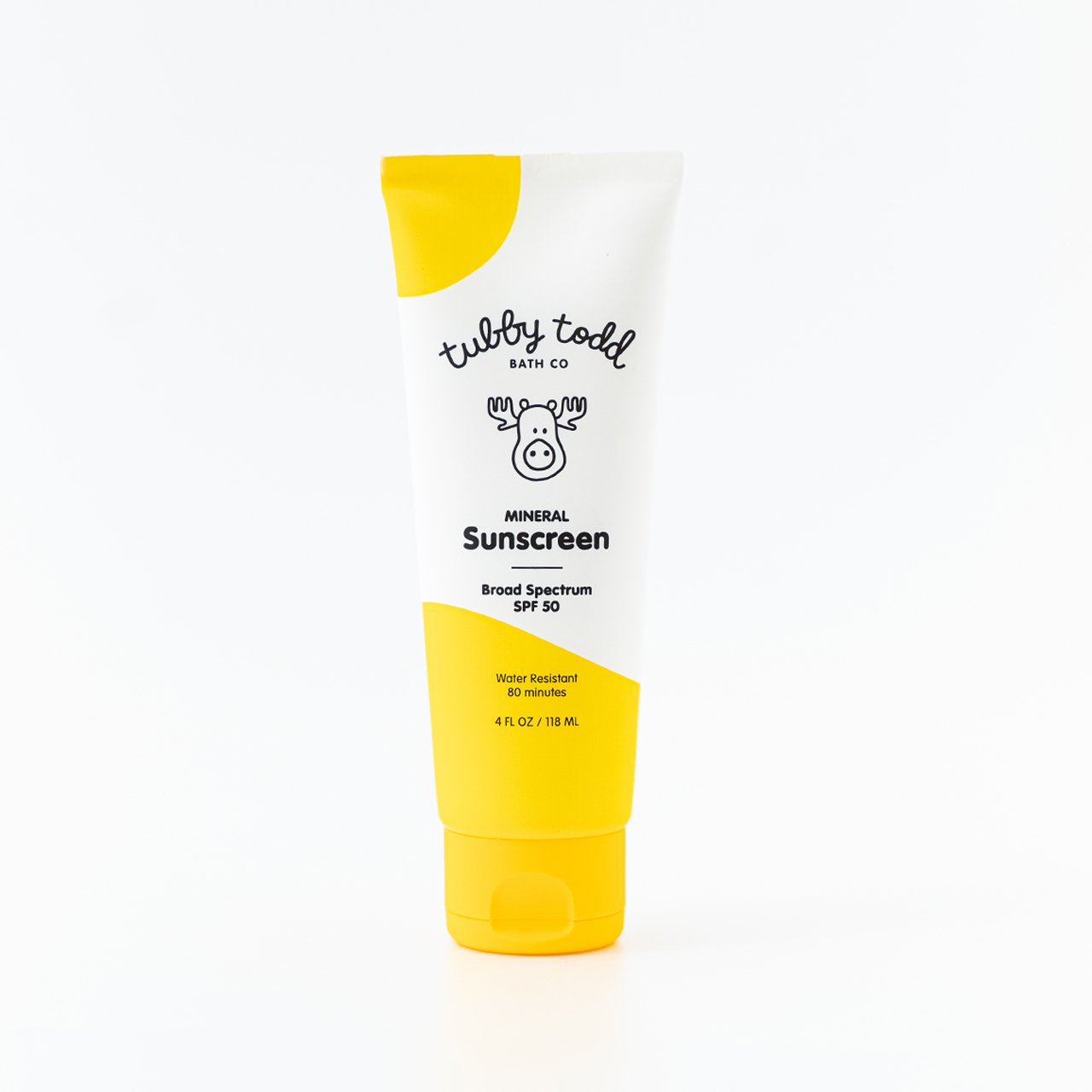
Mineral Sunscreen |
SPF 50 |
Everyday face and body protection |
Our all-around sunscreen with non-nano zinc oxide, 80-minute water resistance, and a moisturizing formula that's ideal for daily outdoor adventures. |
|
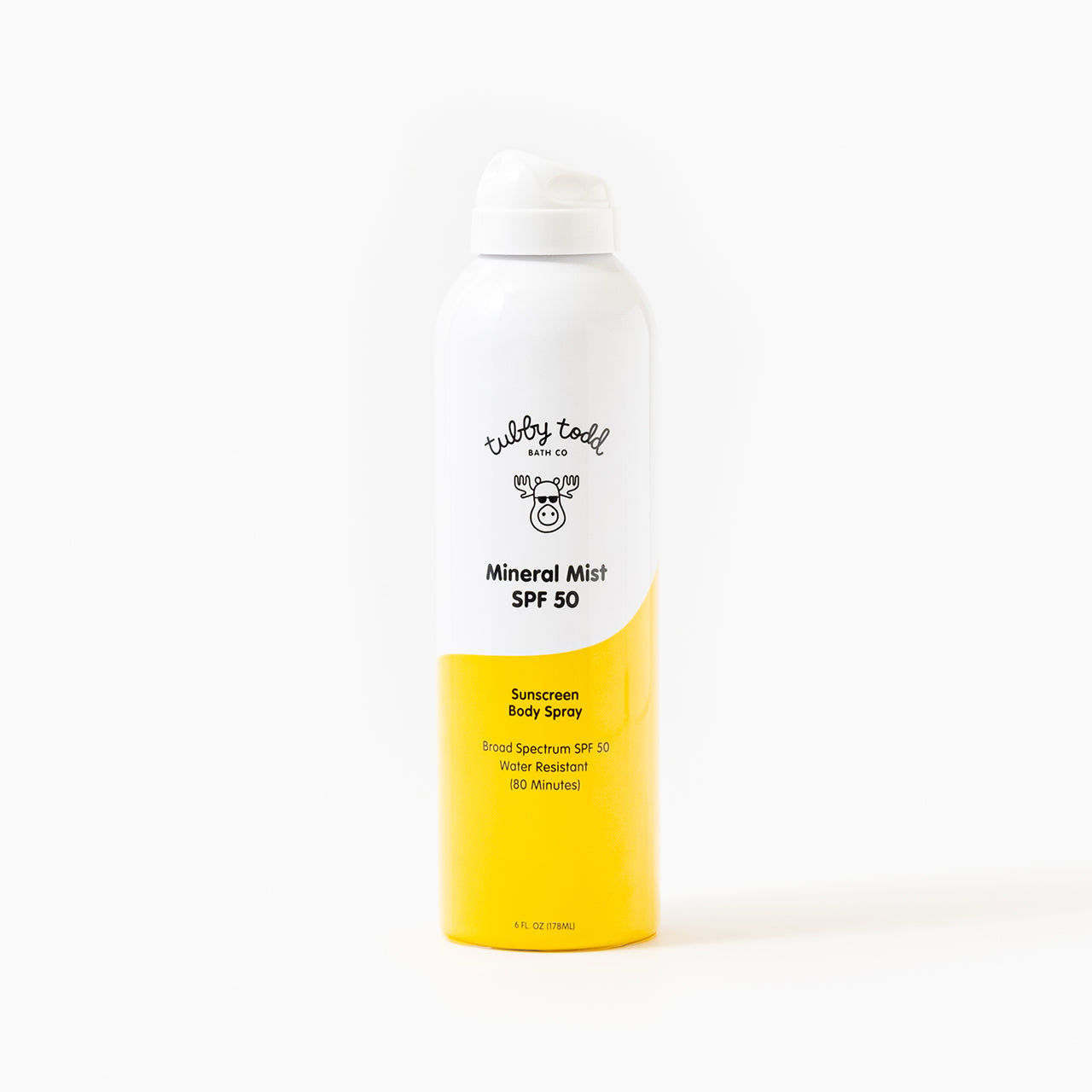
Mineral Mist |
SPF 50 |
Fast application and reapplication |
A non-aerosol mineral spray that's perfect for active toddlers who won't sit still for lotion. Great for beach days, parks, and poolside touch-ups. |
|
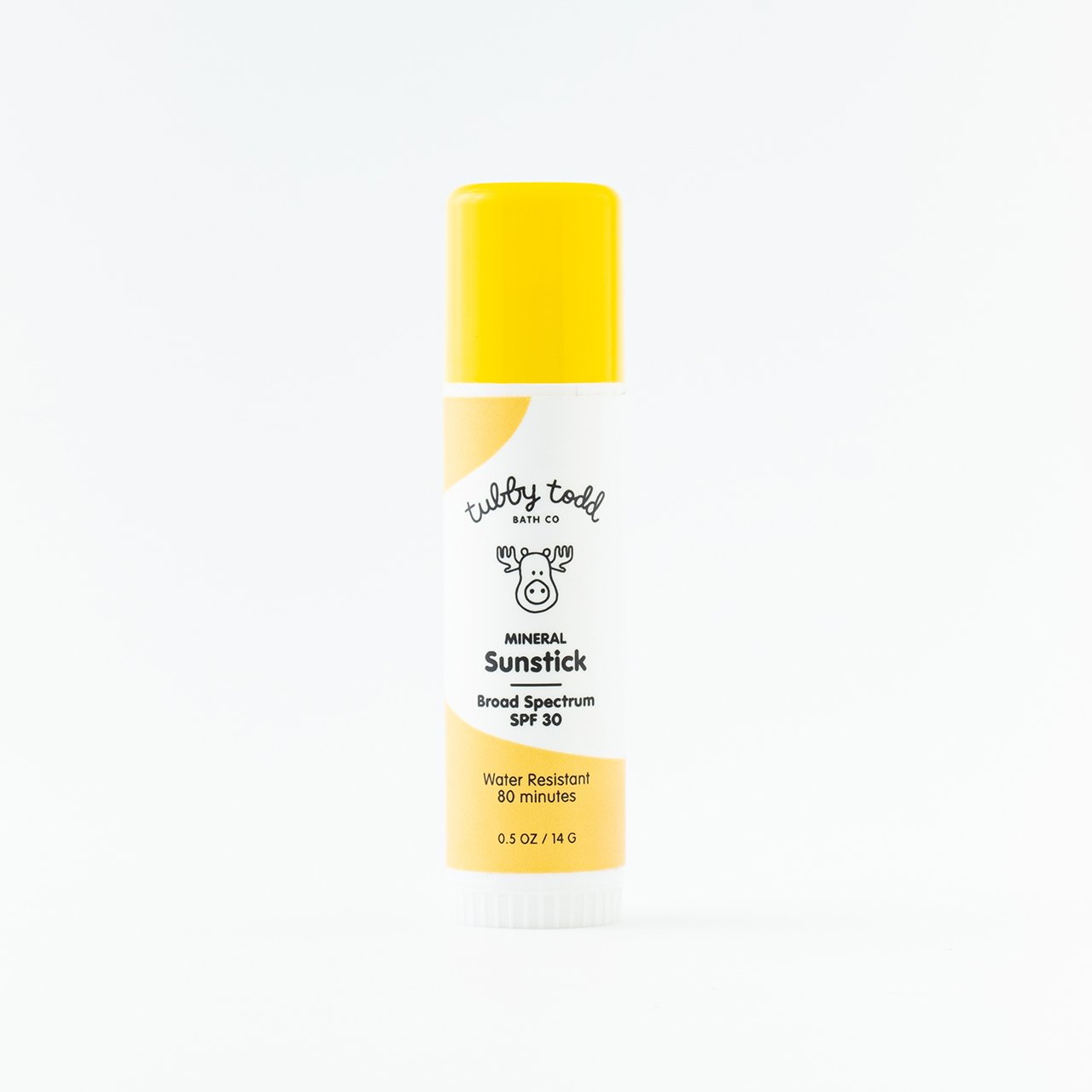
Mineral Sunstick |
SPF 30 |
Face, ears, nose, and on-the-go touch-ups |
Compact, mess-free protection for smaller areas that need frequent reapplication throughout the day. |
|
(S)undercover |
SPF 50 |
Daily facial sun protection |
Lightweight mineral face sunscreen with antioxidants and minimal white cast and added blue light protection, making it a great choice for older kids, teens, and adults. |

Why does baby skin need its own sunscreen?
It is tempting to think a smaller person just needs a smaller dab of whatever you already own. But babies are not tiny adults when it comes to skin, and a few real differences are worth knowing.
Their skin is thinner and more permeable
An infant's skin barrier is still developing, which means anything you put on it can pass through more easily than it would on adult skin. That matters a lot when you are talking about a product you reapply all day, all summer.
Their surface-area-to-weight ratio is higher
A baby has more skin relative to their body weight than you do. So whatever absorbs gets distributed through a much smaller system. The Children's Hospital of Philadelphia notes that kids' developing systems and larger relative skin area are exactly why mineral options are often the safer call for the youngest crowd.
They cannot tell you when something stings
Fragrances, dyes, and some chemical filters are common irritants. A baby with sensitive or eczema-prone skin will just get red and miserable, and you'll spend the afternoon guessing why.
One more thing the pediatric world is firm about: babies under six months should mostly stay out of direct sun altogether. The American Academy of Dermatology recommends shade and lightweight clothing first, and a minimal amount of baby sunscreen only on small areas like the face and backs of the hands when shade is not available. We walk through that under-six-months question with a pediatrician in is sunscreen safe for newborns, and cover the switch to daily wear in our guide to sunscreen for infants. Once your baby is six months or older, baby sunscreen becomes a normal part of getting out the door.
Mineral vs. chemical sunscreen: which is best for babies?
Mineral sunscreen (also called physical sunscreen) uses zinc oxide and/or titanium dioxide. These sit on top of the skin and act like thousands of tiny mirrors, scattering and blocking UV rays before they reach the skin. The FDA lists both zinc oxide and titanium dioxide as “Generally Recognized as Safe and Effective,” the only two sunscreen actives currently in that category.
Chemical sunscreen uses filters like avobenzone, oxybenzone, or octinoxate. These absorb into the top layers of skin and convert UV rays into heat. They tend to rub in clear, which is why a lot of adult formulas use them. The catch: in a 2019 study, the FDA found that several of these chemical filters absorb into the bloodstream at levels high enough to warrant further safety study. The FDA has been clear this does not prove harm, but it is enough reason most pediatric dermatologists steer towards recommending mineral-based formulas for babies.
|
What matters |
Mineral (zinc oxide / titanium dioxide) |
Chemicals (avobenzone, oxybenzone, etc.) |
|
How it works |
Sits on top, blocks and scatters UV |
Absorbs into skin, converts UV to heat |
|
FDA "safe and effective" status |
Yes, both actives |
Under continued safety review |
|
Bloodstream absorption |
Not found at meaningful levels |
Some filters detected in blood |
|
Works the moment you apply it |
Yes |
Needs ~15 minutes to activate |
|
Best for sensitive or eczema-prone skin |
Generally yes |
More likely to irritate |
|
Common downside |
Can leave a white cast |
Possible irritation, reef concerns |
For babies and toddlers, mineral sunscreen is the better fit on nearly every line that counts. The one honest trade-off is the white cast. A good modern formula minimizes it, and frankly, a faint white sheen on a baby is a feature, not a bug, since it shows you exactly where you missed. We talk through the spray version of this in our Mineral Mist FAQs, since a spray solves the "squirmy toddler" problem in a different way.
What about "non-nano" zinc oxide?
You'll see "non-nano" on a lot of baby labels. It refers to the size of the zinc particles. Non-nano particles are larger, so the thinking is they are even less likely to be absorbed and they sit more reliably on the surface. Most pediatric dermatologists prefer non-nano zinc oxide for babies when it is available. Our formulas use non-nano zinc for that reason.
What is the best baby sunscreen for your family? Our top picks
There is no single best baby sunscreen for every family, because a beach morning, a stroller walk, and a quick face touch-up before daycare are three different jobs. Rather than force one bottle to do everything, we built our SPF collection so you can match the right baby sunscreen to the moment. Every option below is mineral, broad-spectrum, fragrance-free, and gentle enough for sensitive skin, and all of them are made for babies six months and up.

Mineral Sunscreen SPF 50: the everyday all-over baby sunscreen
Our bestseller and the one most families start with. The creamy, rub-in Mineral Sunscreen lotion uses 19.6% non-nano zinc oxide for broad-spectrum coverage, stays water-resistant for up to 80 minutes, and contains soothing aloe so skin stays happy under all that protection. Goes on smooth with minimal white cast, which makes it the workhorse baby sunscreen for park days, pool days, and backyard afternoons.
Mineral Mist SPF 50: the baby sunscreen for squirmy toddlers
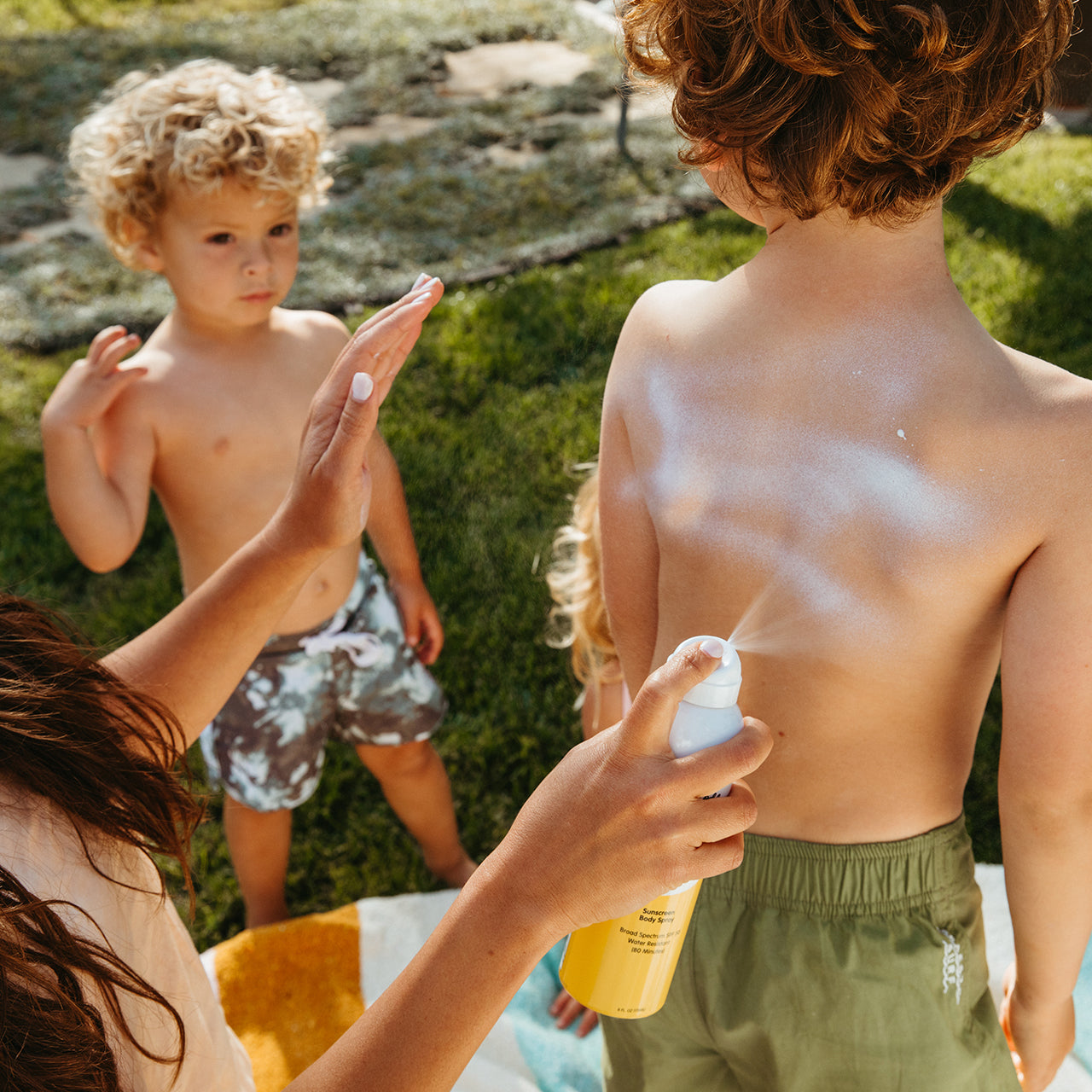
A non-aerosol body spray with 15.7% zinc oxide and 3.4% titanium dioxide, built for the days a toddler treats lotion like a personal insult. The fine Mineral Mist makes reapplication fast at the pool or beach, and it holds up to 80 minutes of water resistance. Spray, rub in, and let them run. We answer the most common questions about it in our Mineral Mist FAQs.
Mineral Sunstick SPF 30: the baby sunscreen for faces and touch-ups
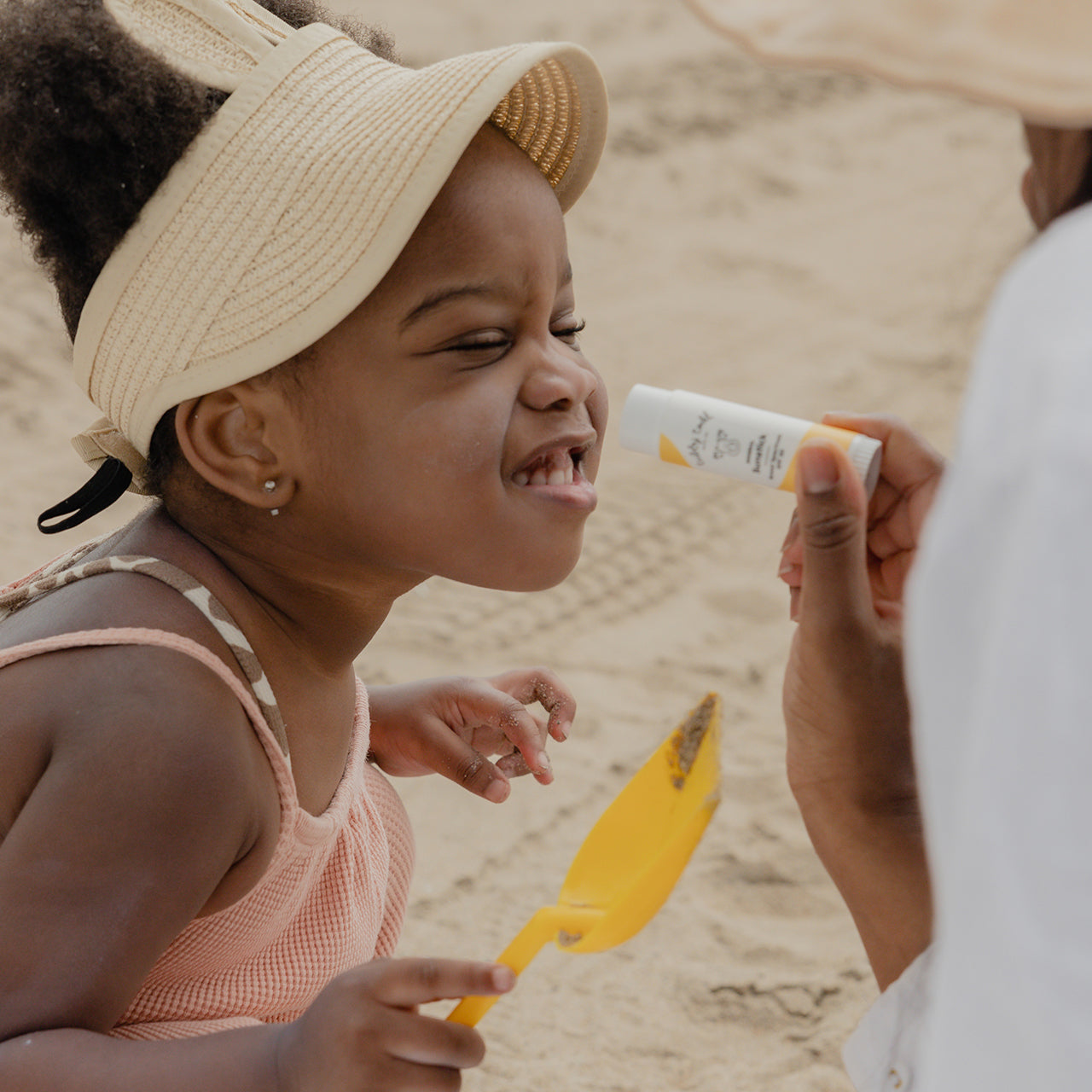
A twist-up stick with 20% zinc oxide that glides on with no messy hands, made for the easy-to-miss spots: noses, ears, cheeks, and hairlines. The Mineral Sunstick is small enough to live in the diaper bag, which makes it the baby sunscreen you will actually reach for mid-outing.
(S)undercover SPF 50: the daily face baby sunscreen
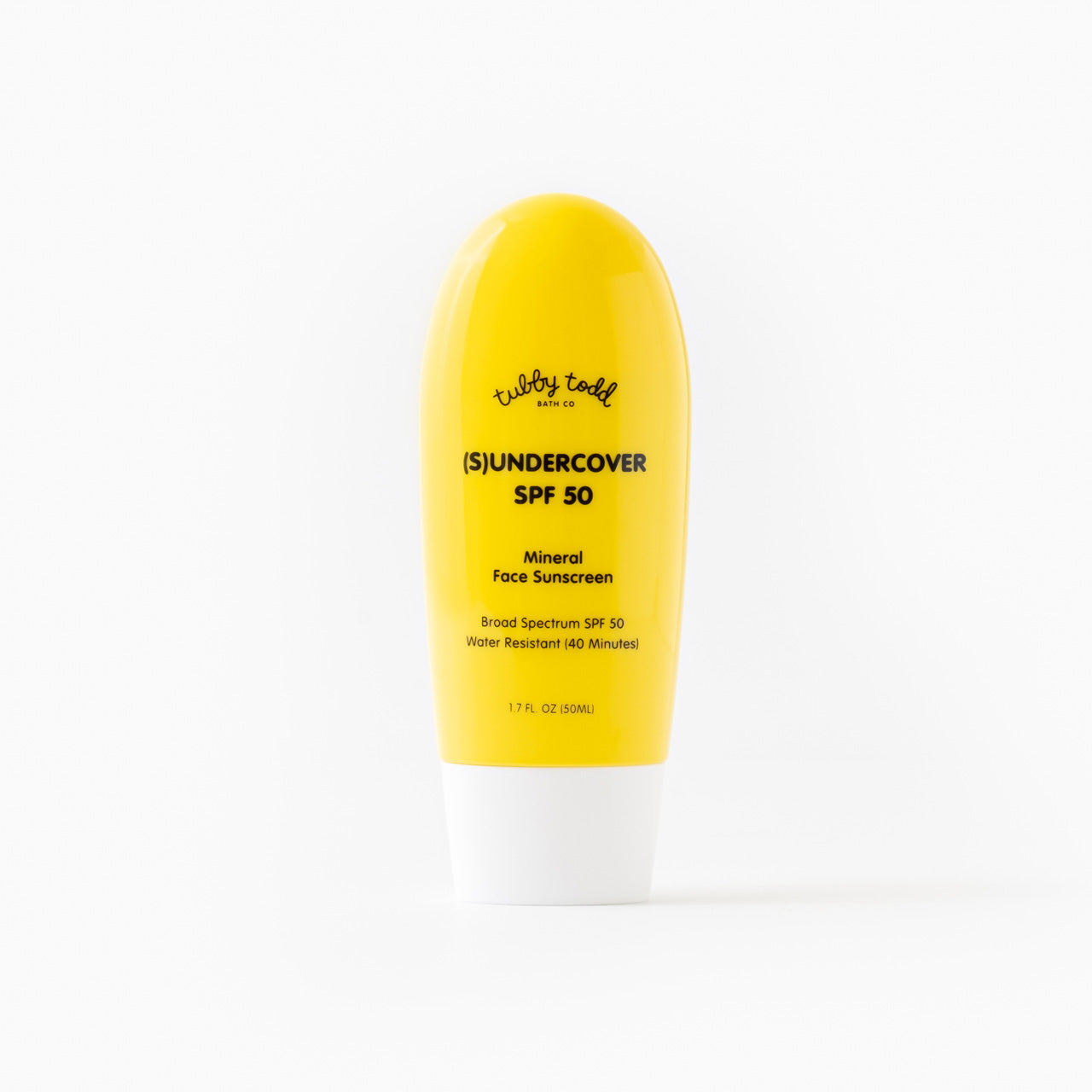
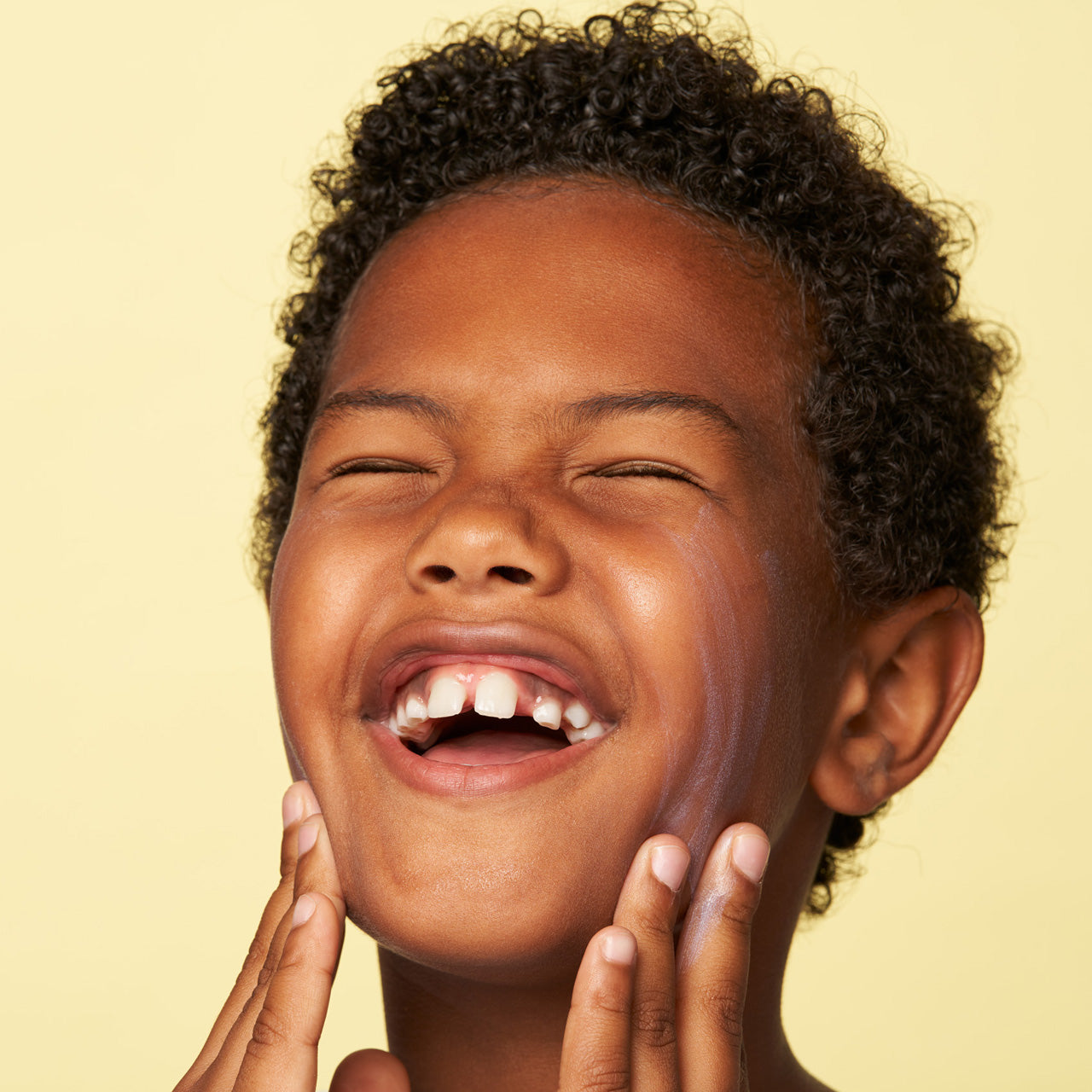
A lightweight mineral face sunscreen serum that absorbs quickly with almost no white cast, so it works as the last step of a morning routine even on days spent mostly indoors. Zinc oxide handles the broad-spectrum UV protection, while added antioxidants defend against blue light and everyday environmental stress. (S)undercover is great for older kids and the grown-ups in the house too.
Which Tubby Todd sunscreen is right for you?
Here is a quick side-by-side so you can pick your best baby sunscreen at a glance:
|
Product |
SPF |
Format |
Key Active |
Best for |
|
Mineral sunscreen |
SPF 50 |
Rub-in lotion |
19.6% zinc oxide |
Everyday all-over coverage |
|
Mineral Mist |
SPF 50 |
Non-aerosol spray |
15.7% zinc oxide + 3.4% titanium dioxide |
Fast reapplication for when your kids are feeling wiggly |
|
Mineral Sunstick |
SPF 30 |
Twist-up stick |
20% zinc oxide |
Faces, ears, on-the-go touch-ups |
|
(S)undercover |
SPF 50 |
Face serum |
Zinc oxide |
Daily face protection, better for older kids and adults |
All four clear the same bar the pediatric world looks for in a baby sunscreen: mineral actives, broad-spectrum coverage, and no oxybenzone or octinoxate. If you want a longer walk-through, our guide to which Tubby SPF product is right for you compares them in more detail.
How do you apply baby sunscreen so it actually works?
-
Use more than you think: A handy guide from dermatologists is the two-finger rule: squeeze a line of sunscreen along your index and middle fingers for each section of the body. The face and neck get two fingers, each arm gets two, and so on.
-
Apply 15 minutes before you head out: Mineral sunscreen works on contact, but applying early gives it time to set so it does not immediately rub off on a sleeve.
-
Smooth, don't rub: The American Academy of Dermatology recommends smoothing sunscreen onto baby skin rather than rubbing it in hard, which can leave thin spots and irritate delicate skin. Don't forget the easy-to-miss zones: ears, the back of the neck, tops of the feet, and that strip of scalp at the part line.
-
Reapply every two hours: And reapply immediately after swimming or heavy sweating, even if the bottle says water-resistant. "Water-resistant" buys you 40 or 80 minutes in the water, not all afternoon. Nothing is waterproof.
A small thing that saves real grief: keep a dedicated bottle in the diaper bag or stroller so reapplying is never a reason to skip it.
What protects baby skin beyond sunscreen?
-
Cover up with UPF clothing: UPF (Ultraviolet Protection Factor) measures how much UV a fabric blocks. A UPF 50 rash guard blocks about 98% of UV rays and never needs reapplying. Long sleeves, lightweight long pants, and a wide-brimmed hat do more reliable work than sunscreen on the parts they cover.
-
Time it around the sun: UV is strongest between 10 a.m. and 4 p.m. The AAP suggests planning outdoor time and checking the day's UV Index. A standing 9 a.m. park trip is gentler on baby skin than a noon one, and usually on baby moods too.
-
Find and make shade: A stroller canopy, an umbrella, or a shady tree all cut exposure significantly. Just remember shade reduces UV, it does not erase it, since rays bounce off sand, water, and pavement. Sunscreen still belongs on exposed skin even under the umbrella.
-
Don't skip sunglasses: Baby eyes let in more UV than adult eyes. A cheap pair of UV-blocking shades, the kind with a soft strap, protects developing eyes on bright days.
Sunscreen should be your last line of defense. If you stack these habits, your actual sunscreen application does less heavy lifting, which means less product on sensitive skin and fewer meltdowns at reapplication time. Because believe us, we’ve been there too.
Ready for an easier summer?
Picking the best baby sunscreen does not have to take up your Saturday morning. Look for mineral zinc oxide, broad-spectrum coverage, water resistance, and a clean ingredient list, and you have already done the hard part. Then layer in shade, UPF clothing, and smart timing so the lotion is backed up rather than the whole plan.
If you'd rather skip the label-reading altogether, our Mineral Sunscreen and the rest of our SPF collection were built to clear every box on that checklist, so you can grab it, get out the door, and get back to the part of summer your kid will actually remember.

Frequently asked questions about baby sunscreen
What is the safest sunscreen for babies?
The safest choice is a mineral (physical) sunscreen with zinc oxide or titanium dioxide as the only active ingredients, ideally non-nano and fragrance-free. These sit on top of the skin instead of absorbing into it, and the FDA lists both minerals as generally recognized as safe and effective. Our Mineral Sunscreen was formulated to those exact specs.
Can I put sunscreen on a baby under 6 months?
Pediatricians recommend shade and clothing first for babies under six months. When shade isn't available, the AAP says you can apply a small amount of mineral sunscreen to exposed areas like the face and the backs of the hands, but you should always check with your pediatrician. Keeping infants out of direct sun is still the priority.
Is mineral or chemical sunscreen better for babies?
Mineral sunscreen is the better fit for most babies. It works on contact, is less likely to irritate sensitive or eczema-prone skin, and is not absorbed into the bloodstream the way some chemical filters can be. Chemical sunscreens rub in clearer but carry more irritation and absorption questions for young skin.
What SPF should baby sunscreen be?
Choose SPF 30 or higher and look for "broad-spectrum," which means it protects against both UVA and UVB rays. SPF 50 offers a bit more margin for the inevitable under-application. Going above SPF 50 adds very little real-world benefit.
How often should I reapply sunscreen on my baby?
Reapply at least every two hours, and right after swimming, sweating, or towel-drying. Water-resistant formulas hold up for 40 to 80 minutes in water, not the whole day, so a fresh coat after pool time is non-negotiable.
Products in this post